
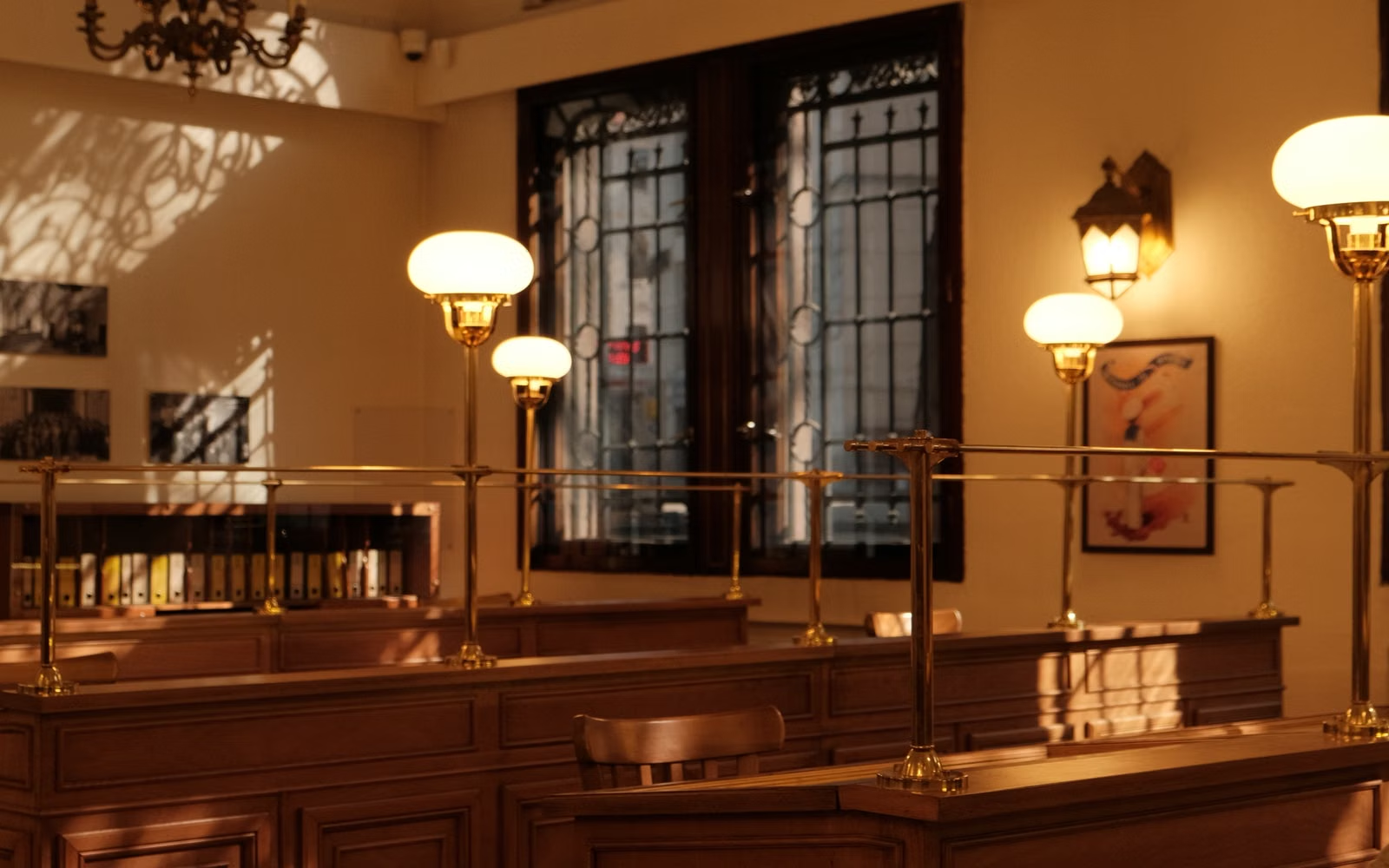
Financial business premises monitoring solution
1. Industry security needs and pain points
Financial institutions are one of the industries with the strictest security requirements. They must prevent external risks such as robbery, fraud, and theft, and they must also satisfy regulatory audits and dispute evidence collection by leaving traces throughout the entire process. Its particularity lies in:
- High compliance standards: There are clear coverage and retention requirements for areas such as counters, self-service equipment, and vaults. Video recordings must be complete, continuous, and cannot be tampered with.
- Human faces are a necessity: The front of the counter is mostly facing the outside due to the glass curtain wall or the strong light from the lobby. Ordinary cameras can only capture silhouettes under backlight.
- Long retention period: The retention period of video recordings in financial institutions is generally longer than that in ordinary industries, which puts forward higher requirements for storage reliability.
- Special form of equipment: The internal space of the ATM machine is narrow and needs to be protected from vandalism, and some locations require concealed installation.
2. Construction Goals
- Business halls, counters, self-service areas, vaults, entrances and exits are fully covered, with no monitoring blind spots.
- Faces and operational details are clearly distinguishable, allowing for subsequent identity confirmation and behavior restoration.
- Videos are retained in their entirety according to the supervision cycle, supporting rapid retrieval and export for evidence collection.
- The system is stable and reliable, and key equipment power outages, network outages, and hard disk abnormalities can be detected in time.
3. Overall system architecture
- Front-end collection layer: Counter wide dynamic dome, lobby panoramic dome, self-service area pinhole/micro camera, ATM special anti-riot model, vault low-light model.
- network transport layer: The monitoring private network is independently carried and physically or logically isolated from the business network to ensure bandwidth and data security.
- storage management layer: Network local storage + upper-level centralized backup dual-track parallel, hard disk redundancy and regular self-checking.
- Application linkage layer: The video is linked with the alarm host, access control, intercom, and ATM vibration detector, and the alarm automatically pops up and records.
4. Key point layout and equipment selection
| point | Recommended models | Key parameters | Monitoring target |
|---|---|---|---|
| teller window | Wide dynamic range network dome camera | Wide dynamic range ≥120dB, face priority exposure | Faces and handover movements between tellers and customers |
| Business hall | HD network dome machine + wide angle dome | Large magnification zoom, cruise | Overall order, suspicious person tracking |
| entrance/exit | WDR waterproof camera | Strong light suppression, backlight compensation | Facial and physical characteristics of persons entering and exiting |
| Self-service banking/ATM | Pinhole or vandal-proof micro cameras | Concealed installation, anti-vandalism, low illumination | Operation panel, cardholder’s face, cash outlet |
| Vault/certificate vault | Low light infrared camera | Motion detection, dual-machine viewing | Full records of double entry and exit and warehouse operations |
| Cash area access | Zoom infrared camera | Corridor mode, backlight compensation | There are no dead ends in the handover and passage process |
5. Core functions and business value
- face clear: Wide dynamic range and strong light suppression technology solve the problem of backlighting in glass curtain walls, making the faces of people entering and exiting visible.
- The video is credible: Supports watermark tamper resistance, time synchronization and integrity verification to meet evidence collection requirements.
- Alarm linkage: After the vibration, door sensor, and emergency button are triggered, the window will automatically pop up, capture and lock the video, and the personnel on duty will respond immediately.
- long term retention: Configure storage capacity according to regulatory requirements, monitor hard drive status in real time, and provide early warning of abnormalities.
- Dispute resolution: Deposit and withdrawal disputes, counterfeit currency, fraud and other incidents can be quickly retrieved and restored to reduce complaints and losses.
6. Implement delivery and service guarantee
- Confirm the coverage requirements point by point based on regulatory specifications and the actual layout of outlets to form a point list.
- Construction must be isolated and protected during business hours, and key operations must be completed at night or during non-business hours.
- Adjust backlight compensation and face exposure parameters point by point, and save samples for acceptance and comparison.
- Complete alarm linkage, time synchronization, backup policy configuration and retention period verification.
- Deliver complete completion data, provide quality assurance and response services, and support branch renovation and relocation.
7. Typical configuration suggestions
Recommendations for standard outlets: one wide-dynamic dome for each station at the counter, 1-2 billiard machines plus wide-angle domes in the lobby, 2 wide-dynamic waterproof machines at the entrance and exit, and 2-3 micro cameras for each ATM in the self-service area (one for the face, one for the cash dispenser, and one for the operation panel). Storage capacity is calculated based on the number of regulatory retention days (usually 30-90 days) and the total code flow, with 20% redundancy reserved. Double storage and off-site backup are recommended for core areas such as vaults.
Related Products
-de803eb1.jpg)
Consult about this solution
Leave your requirement and we will contact you soon.