
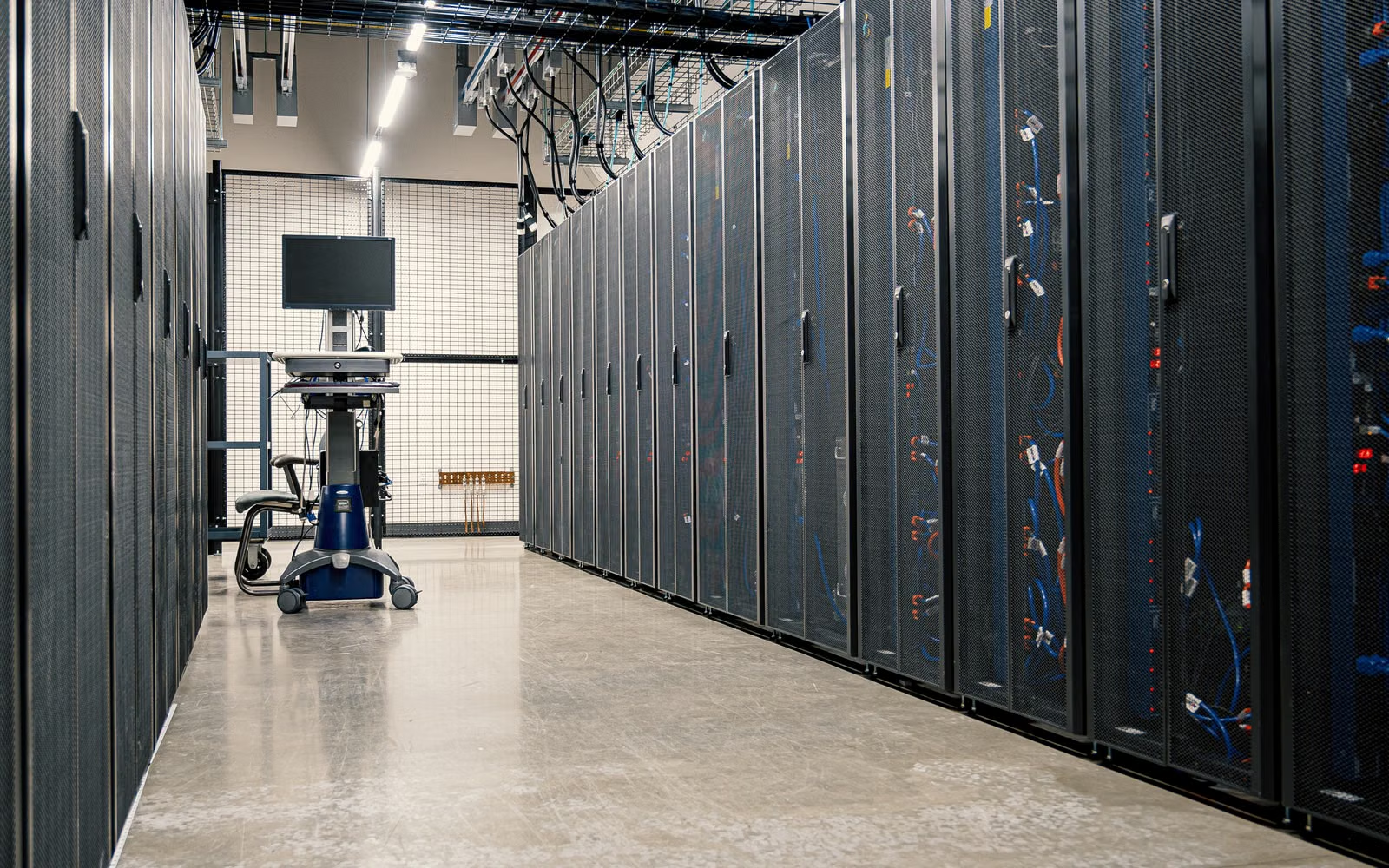
HD network hard disk video recorder storage solution
1. Industry security needs and pain points
The front-end camera determines "clear visibility", and the back-end storage determines "retention and findability". A large number of projects had good images during acceptance, but half a year later they fell into the dilemma of missing videos, slow access, and no one knew about hard drive damage. Common pain points:
- Capacity calculation is inaccurate: The hard drive was estimated based on experience. The actual code flow exceeded expectations and the retention days were far lower than the design requirements.
- Hidden hard drive failure: There is no health monitoring, and the recording is lost silently after bad sectors accumulate on the hard disk, only to be discovered at critical moments.
- Retrieval efficiency is low: It takes a long time to locate a scene in hundreds of videos, and emergency response is passive.
- single point risk: All recordings are concentrated on one device. Once damaged, they will all be lost, lacking backup and redundancy.
2. Construction Goals
- The video is complete and continuous, meeting the design retention cycle requirements.
- The status of hard disk and equipment can be monitored, and abnormalities can be alerted in advance.
- Supports quick retrieval and export based on time, point, event and multiple conditions.
- Critical data has redundancy or backup to reduce the risk of single points of failure.
3. Overall system architecture
- access layer: The network hard disk video recorder is connected to the front-end IPC and supports PoE direct connection or aggregation access through a switch.
- storage layer: Built-in multi-bay hard disk, supports RAID or disk group management, and uses dual-machine hot backup or central centralized storage for key projects.
- Management: Unify device access, stream configuration, recording schedule, user permissions and log auditing.
- Application layer: Real-time preview, video playback, TV wall wall, mobile client remote access and alarm push.
4. Capacity Calculation Method
| resolution | Typical code stream | One-way daily (approx.) | Route 16 30 days (approx.) |
|---|---|---|---|
| 1.3 million pixels | 2 Mbps | 21GB | 10TB |
| 2 million pixels | 4 Mbps | 42GB | 20TB |
| 3 million pixels | 6 Mbps | 63GB | 30TB |
| 4 million pixels | 8Mbps | 84GB | 40TB |
Note: The above is an estimated value for a fixed code stream. If variable code streaming, motion detection recording or smart encoding is enabled, the actual usage can be reduced by 30%-50%. It is recommended to reserve 20% redundancy on top of this.
5. Core functions and business value
- multiple access: Supports multi-channel high-definition network video access and unified management, adapting to projects of different sizes.
- Reliable video recording: Support hard disk hibernation, bad sector isolation and recording protection, and automatically resume recording after abnormal power outage.
- Quick search: Search by timeline, point, and event type, supporting second-level positioning and clip export.
- Remote operation and maintenance: Device status, hard disk health, and network quality are remotely visible, and faults are proactively reported.
- Smooth expansion: It can be gradually evolved from stand-alone to centralized storage, and the initial investment is not wasted.
6. Implement delivery and service guarantee
- Complete the capacity calculation based on the number of points, resolution and retention days and issue a configuration list.
- Standardize cabinet installation, heat dissipation and power supply, and configure UPS to prevent abnormal power outages.
- Set recording plans, alarm policies and automatic coverage rules to verify that the retention days are up to standard.
- Complete remote access, permission grouping and backup policy configuration.
- Deliver operation manuals and expansion suggestions, and provide warranty and spare parts support.
7. Typical configuration suggestions
16-channel 2 million pixels, 30-day retention project: It is recommended to use a multi-slot network hard disk video recorder, configure approximately 20 TB of usable capacity according to the table above (it is recommended to reserve more than 24 TB after redundancy is reserved), and configure UPS and hard disk health alarms. If the project has high reliability requirements, a dual-track solution of "front-end NVR local storage + central centralized backup" can be adopted; when there are more than 64 channels or multiple factories need to be managed uniformly, it is recommended to upgrade to a centralized storage and platform management system.
Related Products
-de803eb1.jpg)
Consult about this solution
Leave your requirement and we will contact you soon.